
Why increase defence spending when ministers don't know what they want to buy?

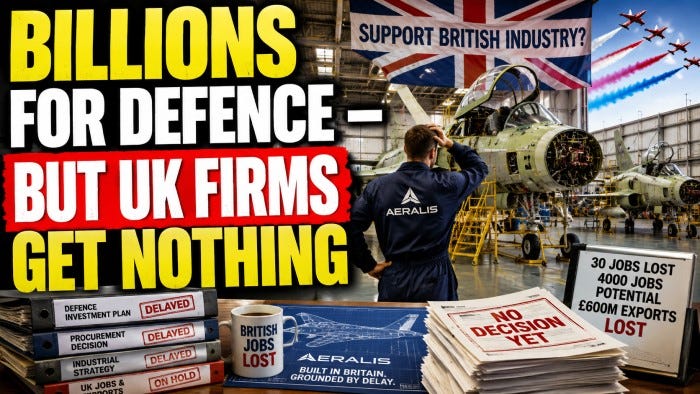
A company that pitched itself as the only British firm able to supply a replacement for the Red Arrows’ fighter jets has gone into administration - saying government funding delays contributed to putting it out of business.
Bosses of Aeralis said the company had faced “a sustained period of pressure” after “continued delays to the UK Defence Investment Plan”, along with “geopolitical” funding issues.
So 30 UK-based jobs have been lost. The company also estimated that its programme could have created 4,000 new jobs in the UK and generated £600 million in annual exports.
Meanwhile, the Ministry of Defence said the government was “backing British jobs, British industry, and British innovators”. Really?
The MoD is considering its options to replace the Hawk fighter jets used by the Red Arrows, which are due to be retired in 2030.
The government’s Strategic Defence Review last year recommended that the Hawks should be replaced by a “cost-effective, advanced trainer jet” - and that MoD procurement should prioritise British businesses to benefit the UK economy.
Remaining candidates to produce a replacement include Boeing/Saab (US and Swedish respectively) in partnership with BAe Systems, and Leonardo - an Italian firm. So much for prioritising UK firms!
The Investment Plan to deliver the Strategic Defence Review’s recommendations has been delayed significantly and Prime Minister Keir Starmer is under growing pressure to publish it. He has told MPs the plan was being “finalised”.
What we’re actually seeing is the gap between announced spending and actual spending - with UK firms paying the cost.
The government can say defence spending is “going up” while companies simultaneously run out of cash, because most of the money is only promised - not immediately reaching projects, contracts, or suppliers.
Much of the headline defence increase is not genuinely new, deployable industrial spending - and firms do not build factories, hire engineers, or secure supply chains based on speeches in Parliament.
Investors want legally committed programmes with timelines and funding streams, otherwise private investors become nervous; banks won’t lend; subcontractors don’t commit; skilled workers go elsewhere and foreign backers pull out.
But probably the biggest obstacle is that governments announce strategic ambitions before deciding what they are actually willing to buy.
The UK has enormous defence spending pressures that demand vast sums of money before smaller projects see anything: renewal of the nuclear deterrent; AUKUS submarine commitments; support for Ukraine; expanding munitions stockpiles; sixth-generation combat aircraft through GCAP/Tempest; naval recapitalisation; army modernisation; cyber and space capability.
An advanced jet trainer is useful, but sits much lower down the hierarchy than nuclear submarines or air defence missiles.
So although ministers talk about supporting British industry, procurement officials are likely to prefer an existing, off-the-shelf, aircraft like the Boeing T-7 Red Hawk or Leonardo M-346 Master because those options are lower-risk and faster to deliver than funding a clean-sheet British design.
That creates the big contradiction: the British state talks about investing in UK industry - but acts like a customer of foreign firms.
Historically, governments deliberately sustained aerospace capability for strategic reasons, even when it was expensive or risky - this was known as strategic planning.
Modern Treasury logic is much more short-term and risk-averse, asking what is cheapest, likely to be delivered fastest, and least likely to fail politically?
If the government wants sovereign defence manufacturing, British jobs, export growth, resilience against geopolitical shocks and reduced dependence on foreign suppliers, this means accepting higher upfront costs and longer development timelines.
In practice, the Treasury still pushes government departments toward immediate affordability and “value for money” calculations.
So ministers rhetorically support British industry while procurement systems often reward established multinational firms with existing aircraft ready to go.
But if every new UK aerospace project is rejected for being “unproven”, then the UK eventually stops having an indigenous aerospace sector capable of producing such aircraft at all.
That tension has haunted UK industrial policy since at least the 1980s.
So the real story is not that a UK company has lost a defence contract.
It is that the UK is spending its defence money elsewhere, procurement decisions are delayed, and UK firms cannot survive indefinitely while the government faffs around trying to work out what it thinks will be acceptable to both the public and the businesses leaning over ministers’ shoulders.
Independent journalism doesn’t fund itself – but somebody has to hold power to account.
That’s what I do here, every day. If you value this kind of reporting, please support it:
Start a paid subscription to The Whip Line for full access to everything I write – or, if you prefer, make a one-off or regular donation at https://Ko-fi.com/VoxPolitical
Independent news survives only when readers like you keep it alive.