
Universal Credit doesn't boost workers - it subsidises Tesco

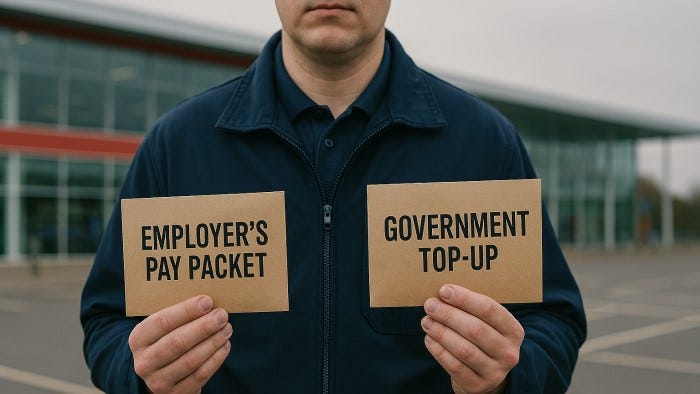
I saw this on social media, on Christmas morning (and it really brought me down to Earth with a bang):
“Tesco makes nearly £4bn profit.
“Nearly 50% of its workforce are on Universal Credit, receiving about £600m a year.
“Why isn’t Tesco paying?”
It isn’t paying because it is merrily cost-shifting: Tesco keeps its wage bill down by relying on the state to make up the difference.
The result is that profits are privatised while labour costs are socialised.
One would have expected a Labour government to oppose that.
You see, if a large share of Tesco’s workforce is on Universal Credit, then those jobs are not economically self-supporting. The public purse is effectively subsidising Tesco’s labour model.
It creates a particularly nasty illusion: by using large numbers of part-time and insecure contracts, Tesco gets to say it “employs hundreds of thousands of people”, while the government gets to boast about lower headline unemployment.
But that doesn’t mean fewer people are being supported by the state. It just means they’re being supported while working, instead of while officially unemployed.
From a public finance perspective, that distinction is almost meaningless.
If someone is working 16–24 hours a week for Tesco and still needs Universal Credit to survive, the Treasury is still paying out. The only difference is that Tesco gets cheap labour and the government gets nicer statistics.
That’s why the claim that “work is the best route out of poverty” collapses here.
For a large chunk of Tesco’s workforce, work is not a route out of poverty at all; it’s simply a condition attached to continued state support.
This also explains why there is no internal incentive for Tesco to improve pay and conditions:
If wages are too low, the state steps in.
If hours are too short, the state steps in.
If contracts are insecure, the state steps in.
From Tesco’s point of view, why change anything? The costs of insecurity are externalised onto taxpayers.
Moral arguments alone won’t shift this. But there are at least three ways a government could respond if it chose to confront this honestly.
First, it could link in-work benefits to employer behaviour: if a company employs large numbers of people who require Universal Credit top-ups, that should trigger scrutiny or additional employer contributions.
In effect, if the state is subsidising your wage bill, you help fund that subsidy.
Second, it could incentivise full-time, secure contracts directly. For example, the government could reduce employer National Insurance contributions for firms that move workers from part-time to full-time roles with predictable hours and wages above a living income threshold.
At the moment, flexibility is rewarded; stability is not.
Third, and this is the part that governments avoid like the Plague, it could publish the full cost of corporate low pay.
This would not just include “how many people are in work”, but:
how many working people are on Universal Credit,
which employers account for the largest share, and
how much each major firm’s workforce costs the public purse.
Frame it that way, and the question, “why isn’t Tesco paying?” becomes unavoidable.
It demonstrates that, right now, Tesco isn’t paying the full cost of its labour.
You are.
The political sting is this: if many of those part-time workers would prefer full-time jobs, then the current system isn’t just inefficient — it’s actively maintaining financial precarity to protect corporate margins and flattering government statistics.
That makes this not just an economic failure, but a democratic one.
Independent journalism doesn’t fund itself – but somebody has to hold power to account.
That’s what I do here, every day. If you value this kind of reporting, please support it:
Start a paid subscription to The Whip Line for full access to everything I write – or, if you prefer, make a one-off or regular donation at https://Ko-fi.com/VoxPolitical
Independent news survives only when readers like you keep it alive.