
Burnham masks questionable future plans with flashy 'Number 10 North' headline

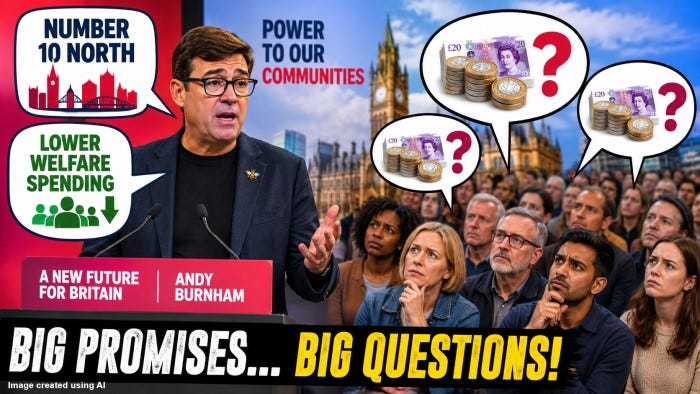
Andy Burnham has started outlining his plans for the future with a flashy promise to spread power around the UK - possibly to hide the less desirable parts of his programme.
The BBC’s coverage of a speech that provided these details focused generously on a proposal to base a new Downing Street team in his beloved Manchester, part of a pledge to redistribute power across the UK, to "drive good growth in every postcode".
Burnham has been advocating this headline policy, of deepening devolution, consistently for years, so there’s nothing surprising about “Number 10 North”.
He’s effectively proposing to institutionalise regional government, and the success of that depends on whether real powers and funding accompany it.
England already has examples of devolution without adequate fiscal autonomy, leaving mayors responsible for problems they lack the resources to solve. Is he going to resolve that issue?
More concerning for me - as a veteran campaigner on the subject - are his plans for the benefit system.
Burnham says he wants welfare cuts that are “fair and lasting”. That’s deliberately broad language.
He says he “wouldn’t be squeamish” about cutting the welfare bill - words intended to reassure people who are worried about public spending. But how is he planning to do that?
If he’s talking about reducing spending by tackling poverty through better jobs, healthier people and fewer households needing support, I would support him. The benefits bill can fall because fewer people genuinely need them and that would be the best way forward.
If he’s talking about reducing spending by tightening eligibility, increasing conditionality or reducing payments, then we’re going to have a problem.
In his speech, he didn’t explain which of these directions he’s taking.
He did say he would want to integrate mental health support with employment support, and this could be read positively.
There is a good argument that many people with mental health conditions receive fragmented support, and better healthcare alongside employment assistance could help some people back into work.
But that doesn’t explain where he’ll find any savings.
So my reading is that “cuts to welfare” should set alarm bells ringing until he explains himself.
Recent governments have habitually presented benefit reductions as “reform”, “modernisation” or “better support” - talking about helping people into work while the practical effect has been tighter eligibility or reduced entitlements.
We should assume that this is also Burnham’s plan if he doesn’t bring forward anything better.
Another reason to doubt him is the incentive on Burnham to reassure financial markets that he has fiscal credibility.
Labour struggles to convince the markets that it won’t launch large unfunded spending programmes - despite the historical fact that it is usually the Conservatives who shake the ‘magic money tree’ for cash and run up the National Debt.
With the benefit bill being one of the biggest cash drains on the public purse, saying he’s prepared to cut benefits is one of the quickest ways to send a positive signal.
But there is very little “easy” welfare spending left. The largest components are pensions, disability-related benefits and support for low-income working households.
If pensions are protected, attention inevitably turns to disabled people and those out of work because of illness - although personally, I would advocate pressuring firms to improve pay for workers.
But all of this is speculation - and that breeds uncertainty, which is precisely what the markets won’t want. That’s why I would want Burnham to answer some very specific questions:
Is he ruling out reducing the real value of disability benefits?
Will eligibility criteria become stricter?
Does he intend to continue or replace the current work capability assessment regime?
Is the objective to reduce poverty and therefore make benefit spending less necessary, or to reduce benefit spending directly and throw people in poverty to the wolves?
Those are the questions that determine whether this is progressive reform or simply another round of austerity directed at the social security system.
At this stage, the speech doesn’t provide enough detail to answer them. It does provide enough reason to ask them.
Beyond that, his speech was striking for the tensions between his different promises.
He talked about:
the biggest council house-building programme since the immediate post-war era;
greater public control over water, energy and transport;
reindustrialisation; and
regeneration
while simultaneously insisting on “sound public finances” and adherence to fiscal rules.
He needs a lot of investment to fulfil those ambitions. If he isn’t prepared to borrow significantly or raise taxation, he’s going to have a hard time finding the cash. The Greens have already raised this point, as detailed in the BBC article.
Burnham’s emphasis on technical education over a university-focused model, on the other hand, isn’t inherently controversial.
Successive governments of all parties have argued for stronger vocational routes, ever since Tony Blair’s focus on academia proved to be a white elephant. So this is not new.
The question is whether it means genuine investment in apprenticeships, FE colleges and technical qualifications, or simply reducing university participation to save money.
We come back, ultimately, to the biggest question - one I have raised before: what kind of Labour government would this actually be?
The apparent combination of decentralisation, state-led investment, municipal government, house-building, an actual industrial strategy… and fiscal caution… resembles aspects of his record as Mayor of Greater Manchester.
He could be signalling that he plans to do what he knows will work - and this is potentially encouraging.
But will he abandon Rachel Reeves’s fiscal rules if they obstruct investment? Will he support significant wealth taxation? How much public ownership is he actually proposing? Is “greater public control” code for regulation, municipal ownership or outright nationalisation? And how will a post-war-scale council house programme actually be financed?
Those answers matter far more than whether Downing Street has an office in Manchester.
“Number 10 North” may become nothing more than the distraction I suggested, if it isn’t accompanied by constitutional reform. Real devolution requires legislated powers, independent revenue-raising capacity and long-term funding settlements.
Otherwise, regional leaders will be nothing more than administrators of Westminster’s will - and we have enough of those already.
So let’s not judge Burnham’s programme by his plan to open a Manchester office.
Let’s keep our minds open - and judge it by what follows over the next few weeks.
His speech sketched out an architecture for government, but left the fundamental economic and constitutional questions unanswered.
Until we have those answers, we can’t know whether this is a genuinely transformative agenda or simply the same tired and failed ideas wearing a different pair of glasses.
Independent journalism doesn’t fund itself – but somebody has to hold power to account.
That’s what I do here, every day. If you value this kind of reporting, please support it:
Start a paid subscription to The Whip Line for full access to everything I write – or, if you prefer, make a one-off or regular donation at https://Ko-fi.com/VoxPolitical
Independent news survives only when readers like you keep it alive.